Gerald is the author of:
The Genius Machine: The Eleven Steps that Turn Raw Ideas Into Brilliance (New World Library, May, 2009).
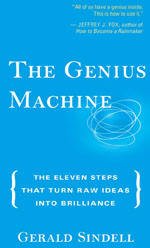
Excerpts from Reviews Posted on Amazon:
 How the world (really) works…, April 26, 2009
By Laurence D. Ackerman “Identity Consultant” (Westport, CT USA)
I am living testimony to the impact of Sindell’s processes, as he used them to help me become conscious of, and articulate, the 8 natural laws of identity that are the foundation of my work and my life. Identity Is Destiny: Leadership and the Roots of Value Creation and The Identity Code: The 8 Essential Questions for Finding Your Purpose and Place in the World. In this respect, Gerry Sindell’s book is really a primer on how to change the world for the better. His precepts, taken together and applied millions of times over, would yield a far more productive society, with benefits for everyone – from the innovators to the populations of people they touch. Read The Genius Machine as a way to revitalize the meaning and impact of your life.
How to develop “brilliant” intellectual property from your “raw” ideas, April 17, 2009
By Robert Morris (Dallas, Texas) (An Amazon Top 50 Reviewer)
“My work is to help people think.” Thus does Gerald Sindell introduce himself. It soon becomes obvious that this is more than a vocation; indeed, it is a passion, a mission, and a crusade to help people develop as many raw ideas as possible (their own as well as others’) into “brilliance.” I agree with him that he is “driven” and very much admire him for that. “The terrible gap that lies between existing knowledge and the persistence of ignorance – and its concomitant poverty, illness, and suffering – drives me crazy.” What we have in this exceptionally stimulating book is everything Sindell has learned about that process…thus far. Some thinking is contemplation (What will I learn from this book?) and other thinking involves problem solving or decision making (Which key points should I stress in my review?). “This book is about a third kind of thinking, one that is directed toward improving an existing idea, thinking through a complete issue, or creating something new….”
According to Sindell, “genius thinkers” look at what everyone else does and see something different; they know who they are (and aren’t) and what they are driven to contribute; they know that nothing exists in a vacuum; they know that the only way to be certain something works is to discover the test that would prove the opposite; they also know they are “standing on the shoulders” of others; and they recognize that, when they have created something of value in any one area, it will probably be of value in many areas; when working with something new, genius thinkers step from time to time and ask: What are the underlying principles operating here? Or are we using new rules, and if so, can they be pulled together into a coherent group or body of law?; they complete their work by answering two questions: Can it stand on its own? Have I provided enough additional information so that what we have innovated can be replicated or continuously improved?; genius thinkers enter the frame of reference of the intended user and ask, “Have I done everything possible to ease the learning curve?”
Thus far, I hope that this review has indicated what Sindell offers in this book without compromising the provision of his key ideas within his narrative. For genius thinkers, there is a stage in the development he calls a “point of no return.” Individuals ask, “Where do I want to go in my career?” whereas genius thinkers as a group ask, “Where do we want to go together?” This stage in the process could also be described as a moment of truth. Sindell offers a head’s up to his reader: “In developing this work, we are about to launch a creation that will eventually take on a life of its own. If this work succeeds in the marketplace, will it help us fulfill our goals?” That is another important question to ask, one that must be answered carefully. If the decision is to proceed, then genius thinkers know that the introduction of even the greatest innovations can easily fail if entrusted to those who were not part of the creation process.
Moreover, “The responsibility to develop the core communication about what has been created begins with the creators.” They and only they must be its primary advocates. Specifically, they must establish their own credibility as well as the legitimacy of what they have created. They must identify and then take full advantage of “advocacy hooks” that will attract and retain support, especially from those who comprise senior management….
Somehow, Sindell succeeds in explaining quite well how to do all this in only 129 pages and then concludes his book with the provision of an immensely valuable mechanism, “The Endleofon Questions.” All of these questions need to be answered so that innovations can be developed to their highest possible level; the answers will also facilitate acceptance of the innovations by the people who would benefit most from them.
…I agree with Jeff Fox that “all of us have a genius inside.” I really do believe that all of us have (out there, somewhere, in some form) a “guardian deity or spirit” that watches over us from birth. I believe that Gerald Sindell can help many of us to release that force of creativity if we are prepared to embark upon and then complete what will prove to be, ultimately, a rigorous exploration of our unfulfilled potentialities.
A bit biased perhaps, but I know of what I speak, April 22, 2009
By Dr. Jim Taylor (Greenbrae, CA)
Full disclosure: I have known Gerry for about 15 years and he has assumed many roles in my life: mentor, manager, friend, officiant at my wedding, book doctor, just to name many. He was instrumental in the development, sale, and success of my two parenting books, Positive Pushing: How to Raise a Successful and Happy Child (Hyperion, 2003) and Your Children are Under Attack: How Popular Culture is Destroying Your Kids’ Values, and How You Can Protect Them (Sourcebooks, 2005).
Just to give you an idea of the value of Gerry’s ideas found in The Genius Machine, the first iteration of Positive Pushing was bought for a four-figure advance by a small publisher who later bailed on the project. After a major restructuring and rewrite of the manuscript led by Gerry, the much-changed book sold to Hyperion for a six-figure advance. He is currently helping me prepare three new book proposals. To learn more about my work, […]
You might think then that I am too biased to provide an objective assessment of Gerry and his book, The Genius Machine (and you may be right). At the same time, I can speak as living proof of the value of The Genius Machine and the ideas that lie within it. So perhaps consume what I say with a grain of salt, but please do consume it.
Quite simply, the ideas in The Genius Machine work. I have gone through the Endleofon process many times with my book ideas and am always amazed at what emerges at the end of journey; often hardly resembling the original idea, yet so much more clear and compelling.
The Genius Machine has the unique ability to take an idea–a diamond in the rough, if you will–and help the originator of the idea to focus it, sharpen it, direct it, and express it in its most effective form. The Genius Machine not only helps to articulate and communicate the ideas most clearly, but it also helps to shape them into a form that is highly marketable.
The Genius Machine will certainly be a “must-read” for anyone who has an idea, but doesn’t quite know what to do with it.
And, BTW, having Gerry in the flesh work with you is an even greater gift.
Evaluate the Power of Your Thoughts!, April 22, 2009
By Thomas Signer (Zurich, Switzerland)
“If you were not successful in getting your way of seeing things out into the world, what is it the world would have lost?” Focusing on this key question, Sindell methodically constructs a framework which enables us to test out our ideas for their power. What is of particular merit is that he hands readers a “pilot’s checklist” empowering the reader to distinguish plain vanilla from the TRULY POWERFUL thoughts – those that can change the readers’ lives and the lives of others for the better. His framework is simple, yet compelling. This timeless reference work should be consulted whenever someone thinks they are on to something big – and they want to be sure of it.
Quick Read and Powerful!, April 16, 2009
By Bea Fields “Bea Fields” (Southern Pines, NC) – See all my reviews
If you ever doubted that you can take your idea and turn it into something brilliant that can impact others, you must read The Genius Machine. The book is a quick read but so very powerful. I felt myself moving in a different direction today…adding more value, being more patient and bringing more ideas to the table with each conversation.
Pick up a copy…you can read it in an evening and trust me…you will wake up the next morning with a brand new view of the world.
Running Ideas Through the Genius Machine, April 14, 2009
By Janet Boyer “JanetBoyer.com” (Pennsylvania) (An Amazon Top 50 Reviewer)
“Innovation begins with a need–whether it’s the next-generation high-speed switch, a change in corporate culture, the design for a flagship product, or finishing a book on deadline. Throughout our lives we are met with challenges to create something that isn’t already there. We can either do decent work and make something that, at the very least, does the job, or we can come up with something that is simply brilliant. In many ways, the choice is yours.” – From The Genius Machine
What is a genius thinker? According to author Gerald Sindell, founder of Thought Leaders International, a genius thinker is one who looks at what everyone else has looked at and sees something new.
In his new book The Genius Machine, Sindell distills the eleven-step revolutionary system he has used to guide leaders, organizations, and authors. By taking an idea and then running it through Sindell’s innovation hopper, concepts are subjected to critical thinking, including differentiation, implication, refinement and advocacy….
Here are few fascinating nuggets from The Genius Machine:
* “Identity is the source of that feeling deep inside us that says we have something we were meant to do in this world, and that if we could just find it, we’d be on the right path. Fortunately, we *can* find it.”
* “Geniuses always have their antennas out for shuffle-the-deck breakthroughs in their own immediate area and in the world in general. This is one reason why we need to develop our own personal array of filters that we bring us the information we need as soon as it happens. Shuffle-the-deck breakthroughs in the Great Conversation changes the conversation.”
* “Elegance is inherently attractive: simplicity is artful. In thinking and writing, too, elegance is appealing. When we have refined our thinking to the point that our hard work has become invisible, then we will have achieved elegance. Elegant thinking has many advantages over its cruder competition: elegance communications more efficiently, is likely to be adopted faster, and will often have the strength to fend off the competition.”
* “If you were not successful in getting your way of seeing things out in the world, what is it the world would have lost?”
* “We can often discover our entire framework by looking closely at any single element of what we’re creating, since the truth of the whole is carried in every one of its parts. Everything we create, in each of its parts, expresses our values, our expression of what we think is the nature of life and humankind, our hopes for ourselves and the world.”
From business to psychology, publishing to education, medicine to software development, The Genius Machine provides anyone with a brilliant vision, complex problem, or timely invention with a step-by-step plan for defining, refining, polishing and producing those ideas and solutions. In fact, a development cycle that might take months or years could feasibly be reduced to days or weeks using the Endeofon system.
Have a book you want to write? Put it through the Genius Machine. Invented a product that could change the world? Run it through the Endleofon system. Up against a corporate problem, human resource hemorrhage, or strategy snafu? Again, take it through Gerald Sindell’s eleven-step process to gain clarity.…
Whether you’re a CEO or an educator, a writer or a student, a scientist or farmer, The Genius Machine can literally take your intellectual property, put it through the Endleofon hopper, and churn out brilliance. The funny thing is, though, that once you begin thinking like a genius via Sindell’s method, you’ll never see yourself, your ideas, or the world quite the same again.
New Perspectives That Could Not Be Left Aside July 8, 2009
By Guillermo Mendoza “agmenta” (Guadalajara,, Jalisco Mexico)
I have been in the corporate world and now doing my own projects in the Tequila Industry World and I found The Genius Machine an excellent recollection of experiences that Gerald put together wrapped in a rather complete conceptual frame. I flew from Denver to México and could not stop reading and comparing with other books. I used in the past the work of Robert Fritz ” The path of least resistance” which is a very good work as well but I found in Gerald’s book a number of new perspectives that could not be left aside when doing long range project. I recommend it widely.
Genius by Design with The Endleofon Process, A Disciplined & Systematic Thinking-Through Methodology, July 7, 2009
By Lee Say Keng (Singapore) (An Amazon Top 500 Reviewer)
As an avid reader, it is not surprising for me to note that books about how to create ideas are a dime a dozen. Just pop into any physical book store in the city or browse the Amazon catalog – you will be astonished!
We all know most ideas often come to us as fuzzy, weak & half-baked; sometimes – with a little bit of intervention – as sketchy concepts on paper or nifty scribblings on the back of a napkin.
So, we come to a harsh reality: how to turn a raw idea into a blockbuster product or service, or how to convert a vague, unpolished thought into a powerful idea that can the world?
Even world-renowned creativity guru, Edward de bono, with his huge repertoire of printed books & published writings on lateral thinking, has yet to come up with a disciplined idea development methodology, even though his classic, ‘Opportunities: A Handbook for Business Opportunity Search’, has great stuff, which a reader unfortunately needs to sort out diligently for application.
So, we are back to square one. Not exactly so.
I have recently read a new book, entitled The Genius Machine: The Eleven Steps that Turn Raw Ideas into Brilliance, by Gerald Sindell, a former book publishing executive & former Hollywood film producer.
The author’s Endleofon Process is encapsulated in the book – there are eleven stages; hence, the name ‘Endleofon’, which is an old English word for the odd number – with each stage of the elegant process covered by each chapter.
As I see it,’The Endleofon Process’ as embodied in the book is a disciplined, systematic thinking-through methodology.
With it, I am convinced that any one, through diligent application, can get to enhance his or her thinking by deliberating purposefully – via a meaningful series of provocative questions at each stage – on an issue or a project, all the way to its productive outcome.
Here’s a quick bullet summary of the process stages:
1) DISTINCTIONS;2) IDENTITY; 3) IMPLICATIONS; 4) TESTING; 5) PRECEDENT; 6) NEED; 7) FOUNDATION; 8) COMPLETION; 9) CONNECTING; 10) IMPACT; 11) ADVOCACY;
From a tactical perspective, the eleven process stages are great for anyone to use them for exploring his or her creative assets, &/or mining his or her inventive mind.
The author writes with warmth, candour & succinctness. His many personal anecdotes as well as crisp examples of real-world application are easy to understand. Best of all, his easy-going writing style also makes reading -by the way, less than 150 pages – a breeze!…
To conclude my review, I reckon the real gem in the book lies, in addition to the methodology, in the thoughtfully-crafted ‘The Endleofon Questions’ which the author has dutifully assembled at the end of the book, as well as also those probing ones already interspersed within all the chapters.
Many thanks, Gerald, for a great masterpiece!
This 11-step process is a proven key to successfully realizing ideas and bringing them to fruition, June 16, 2009
By Midwest Book Review (Oregon, WI USA)
This step-by-step system for developing an idea or creating and innovation helps people uncover and use their own innate genius and comes from an intellectual property consultant who works with individuals and organizations alike. His 11-step process is a proven key to successfully realizing ideas and bringing them to fruition, and makes for a powerful presentation.
The epiphany I needed!, May 9, 2009
By Lise Stewart (Boise, ID United States)
I am in the middle of trying to move an organization of very smart and committed people, my partners and employees, forward in a direction that is new for all of us. However, I had not been able to truly identify why we were stuck and what to do about it. Then, in reading The Genius Machine, I experienced an epiphany. I had missed the mark – missed the opportunity to more clearly define/touch/communicate my identify and, in turn, our collective identity. In addition, our process lacked the structure – the simple, elegant structure we needed. Based on the book, I wrote a letter to my team and proffered a new way of looking at the product/program we have been developing over the past year.
The response has been quite extraordinary. Using Gerald Sindell’s 11 steps, we redesigned our product, simplified our core program and restructured our launch. While it would take too much space to go into details, I want to stress that we are a professional consulting organization that assists clients in new product and service innovations all the time. We have tried a lot of different methodologies and tested different systems – but the beauty of this process is its simplicity – and the way it is clearly articulated. I can recommend this book to all of my clients around the country with confidence that it can not only be easily understood, but also, practically implemented.
An Elegantly Simple Book, May 4, 2009
By Winford E. Holland “Dutch” (Houston, Tx USA)
It really is an elegant book … and that is the highest compliment I can pay!
Genius Machine is Brilliant, April 29, 2009
By Ron Mattocks “Ron” (Fairfax, VA)
The Genius Machine shines brilliantly as a tribute to Gerald Sindell’s lifelong commitment to crafting raw ideas into sparkling gems, and helping others do the same. Sindell declares that “Genius thinkers recognize that, when they have created something of value in any one area, it will probably be of value in many areas.” The maxim applies perfectly to this book, which is of value to creatives in so many different walks of life.
If you are involved in creative development on any front, this book is for you. I have worked through many of these concepts with Gerald Sindell’s help, which resulted in the publishing of my first book, Zone of Insolvency. Practical applications of the eleven steps are bigger than life. Read The Genius Machine today!